






Can I Buy Gold with My Traditional IRA?

Yes — but not directly through a traditional IRA. Standard IRAs (held at Fidelity, Vanguard, Schwab) are limited to stocks, bonds, ETFs, and mutual funds. To hold physical gold, you must open a Self-Directed IRA (SDIRA) with a custodian licensed for alternative assets under IRC §408(m)(3)(B).
This is a hard IRS requirement. Attempting to hold physical gold in a regular brokerage IRA — or store it yourself — triggers an immediate deemed distribution with full income taxes and a 10% early-withdrawal penalty if you are under 59½ (confirmed by McNulty v. Commissioner, 157 T.C. 10, 2021).
Exception: Gold ETFs (like GLD or IAU) can be held in a traditional IRA, but they give you paper exposure, not physical metal. If you want physical gold with IRA tax advantages, a Gold SDIRA is the only compliant path.
IRS-Approved Gold: Purity Requirements & Eligible Coins
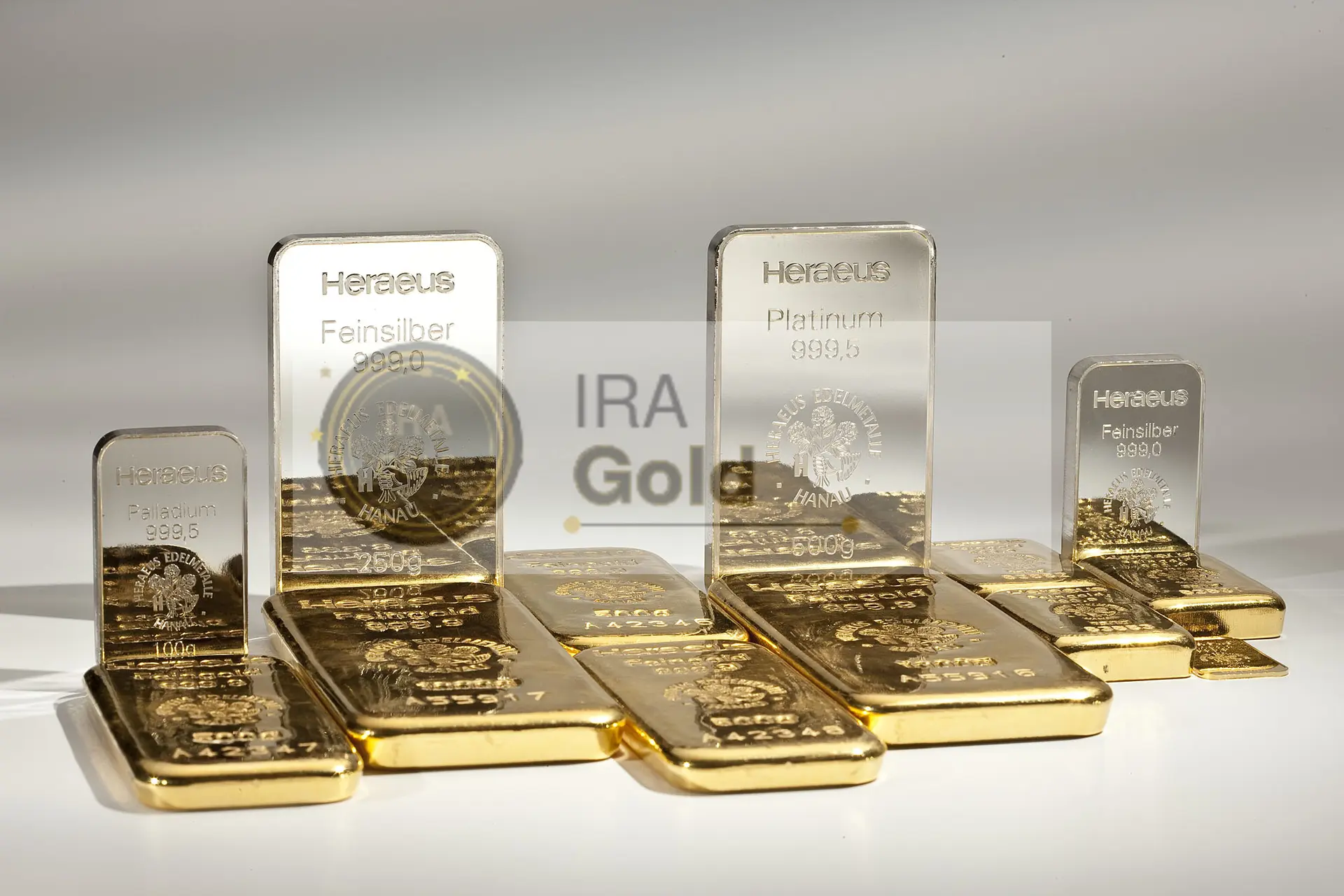
Under IRC §408(m)(3)(A), gold held in an IRA must meet 99.5% fineness (995/1000) — with one statutory exception for American Gold Eagle coins, which are 91.67% pure (22 karat) but explicitly approved by Congress. All other gold must meet the 99.5% threshold.
IRS-Eligible Gold Coins
- American Gold Eagle (1 oz, ½ oz, ¼ oz, 1/10 oz) — 91.67% — the only sub-99.5% exception
- American Gold Buffalo (1 oz) — 99.99%
- Canadian Gold Maple Leaf (1 oz, ½ oz, ¼ oz, 1/10 oz, 1/20 oz) — 99.99%
- Austrian Gold Philharmonic (1 oz, ½ oz, ¼ oz, 1/10 oz) — 99.99%
- Australian Gold Kangaroo / Nugget (1 oz) — 99.99%
- British Gold Britannia (2013+, 1 oz) — 99.99%
IRS-Eligible Gold Bars & Rounds
Any gold bar or round produced by a NYMEX/COMEX-approved assayer, NYSE/Liffe-approved refiner, national government mint, or ISO 9000 accredited manufacturer — provided fineness is 99.5% or higher. LBMA (London Bullion Market Association) accreditation is the global gold standard: LBMA-accredited refiners produce bars that meet IRS fineness requirements and are universally accepted by all approved depositories. Popular LBMA-accredited brands: PAMP Suisse, Credit Suisse, Valcambi, Perth Mint, RCM (Royal Canadian Mint), Argor-Heraeus.
NOT IRS-Eligible
- South African Krugerrand (91.67% but NOT congressionally exempted)
- Gold collectibles, numismatic coins, or jewelry
- Pre-1933 U.S. gold coins (unless specifically ruling-approved)
How to Buy Gold in an IRA: Step-by-Step (No Broker Required)
You do not need a traditional stockbroker to buy gold in an IRA. The process goes through a Gold IRA company (which acts as your precious metals dealer) and an SDIRA custodian. Many Gold IRA companies handle both functions or partner with a custodian so the process is seamless.
Step 1: Choose a Gold IRA Company & Custodian
A Gold IRA company is a precious metals dealer that specializes in IRA-eligible products. They often partner with or recommend specific SDIRA custodians (e.g., Equity Trust, Kingdom Trust, Strata Trust). Compare: setup fees ($50–$300), annual custodian fees ($75–$300/yr), storage fees ($100–$300/yr), dealer markup over spot (1–5%), and BBB complaint history.
Step 2: Open Your Self-Directed IRA
Complete the custodian’s SDIRA application — typically online in 15–30 minutes. You will need: government ID, Social Security number, beneficiary information, and bank account for initial funding. Processing: 1–3 business days. The custodian files IRS Form 5498 annually to register the account.
Step 3: Fund Your Account (Rollover or Contribution)
Direct Rollover (most common): Request a trustee-to-trustee transfer from your 401(k), 403(b), TSP, or existing traditional IRA. No taxes withheld, no 60-day deadline, no limit on amount. Process: 5–10 business days.
Indirect Rollover: You receive the distribution and must deposit it into the SDIRA within 60 days. Your old custodian withholds 20% for taxes (refunded when you file), and you are limited to one indirect rollover per 12-month period across all IRAs.
Annual Contribution: $7,000/year (2026); $8,000 if age 50+. Requires earned income.
Step 4: Select & Purchase IRS-Approved Metals
Once funded, direct your Gold IRA company to purchase specific IRS-eligible products. You choose the coin or bar type; the dealer handles the trade at the current spot price plus a bid-ask spread of 1–5% depending on the product. LBMA-accredited refiners (PAMP Suisse, Valcambi, Credit Suisse) produce the most widely accepted bars. Your Gold IRA company ships the metals directly to an IRS-approved depository — you never take personal delivery.
Step 5: Metals Are Shipped to an IRS-Approved Depository
Under IRC §408(m)(3)(B), your SDIRA custodian sends the metals to a qualified depository — Delaware Depository, Brink's, or CNT — within 5–10 business days of purchase. Common depositories: Delaware Depository (Wilmington, DE), Brink’s Global Services, CNT Depository (Bridgewater, MA), IDS of Delaware, Texas Precious Metals Depository. Storage options: segregated (your specific bars/coins in a dedicated vault — $150–$300/yr) or commingled/allocated (pooled storage — $100–$150/yr). Insurance typically covers up to $1 billion.
Gold IRA Fees: Complete Breakdown ($300–$700/yr Total)
Expect $300–$700 per year in total Gold IRA fees: $75–$300 custodian admin + $100–$300 storage + a one-time $50–$300 setup fee, plus a 1–5% dealer markup over spot price on every purchase. Unlike a Vanguard ETF with a 0.25% expense ratio, Gold IRA fees are flat-dollar — meaning they are proportionally more expensive for smaller accounts (a $20,000 account paying $500/yr in fees carries a 2.5% effective annual cost).
| Fee Type | Typical Range | Notes |
|---|---|---|
| Setup / Account Opening | $50 – $300 | Often waived for accounts over $50k |
| Annual Custodian / Admin | $75 – $300/yr | Flat fee, not % of account value |
| Segregated Storage | $150 – $300/yr | Your specific metals in a dedicated vault |
| Commingled Storage | $100 – $150/yr | Pooled with other customers' metals |
| Dealer Markup (over spot) | 1% – 5% | On purchase only; varies by coin/bar type |
| Estimated Annual Total | $300 – $700/yr | Excluding one-time purchase markup |
Fidelity Gold IRA note: Fidelity does not offer a self-directed Gold IRA for physical metals. They offer gold ETFs (GLD, IAU) and commodity exposure in their standard IRA accounts, but not physical bullion storage. For physical gold, you need a specialized SDIRA custodian.
Gold IRA for Beginners: Key Rules & Common Mistakes
The three most expensive Gold IRA mistakes beginners make: (1) opening a home storage account and triggering a deemed distribution, (2) choosing a custodian based on advertised minimums without reading the annual fee schedule, and (3) missing the 60-day rollover deadline on an indirect rollover. Here is what to know before you start.
The Home Storage Myth (Prohibited Transaction)
Despite aggressive marketing of "home storage Gold IRAs," the IRS treats storing IRA metals at home as a prohibited transaction under IRC §4975. The Tax Court confirmed this in McNulty v. Commissioner (157 T.C. 10, 2021). The entire IRA account value becomes taxable as ordinary income in the year of the violation, plus a 10% early-withdrawal penalty if you are under 59½. A $200,000 Gold IRA stored at home could generate a $60,000+ tax bill in a single year.
Gold IRA vs. Physical Gold: Which Is Better?
Gold IRA advantages: Tax-deferred (traditional) or tax-free (Roth) growth; no 28% collectibles capital-gains rate on appreciation inside the account; direct rollover from 401(k)/403(b)/TSP without triggering tax; Roth conversion eligible.
Physical gold advantages: No custodian or storage fees; immediate liquidity; no RMDs; full physical possession; no UBIT (Unrelated Business Income Tax) exposure.
Choose a Gold IRA if you are rolling pre-tax retirement dollars; choose physical gold if you are investing after-tax cash you may need before 59½.
Gold IRA Minimum Investment
Most reputable Gold IRA companies require a minimum investment of $10,000–$50,000. Augusta Precious Metals: $50,000 minimum. Goldco: $25,000. American Hartford Gold: $10,000. Birch Gold Group: $10,000. Noble Gold: $20,000. Accounts under $25,000 often pay 3–5% in effective annual fees due to flat-fee structures — run the math before committing.
Gold as an Inflation Hedge: The Data
Gold’s role as an inflation hedge is supported by central bank behavior: global central banks added 1,037 tonnes of gold in 2023 (World Gold Council), the highest annual purchase since 1967. Under Basel III regulations (effective 2023 in the EU and UK), central banks reclassified gold as a Tier 1 zero-risk-weight asset — the same category as cash — signaling renewed institutional confidence. For retail investors, a 5–10% gold allocation has historically reduced portfolio volatility without sacrificing long-term returns.
Gold IRA vs. Traditional IRA vs. 401(k): Key Differences
Understanding how a Gold IRA fits within your broader retirement strategy requires comparing it to standard account types:
| Feature | Gold IRA (SDIRA) | Traditional IRA | 401(k) |
|---|---|---|---|
| Holds Physical Gold | Yes | No | No (usually) |
| 2026 Contribution Limit | $7,000 / $8,000 (50+) | $7,000 / $8,000 (50+) | $23,500 / $31,000 (50+) |
| Tax Treatment | Tax-deferred growth | Tax-deferred growth | Tax-deferred growth |
| Annual Storage Fee | $100 – $300/yr | None | None (fund expense ratios) |
| RMDs at 73 | Yes (can be in-kind) | Yes | Yes |
| Rollover Eligible | Yes (from 401k, IRA, 403b) | Yes | Yes (if separated from employer) |
Best Gold IRA for large account balances: Augusta Precious Metals (minimum $50,000, white-glove service) and Goldco ($25,000 minimum, strong educational resources) are consistently rated highest for accounts over $100,000. For accounts under $25,000, Birch Gold Group and American Hartford Gold offer lower minimums with comparable service.
Gold IRA Minimum Investment: What You Actually Need to Start
Most custodians require $10,000–$50,000 to open a Gold IRA; a few accept $5,000, but sub-$25,000 accounts often pay 3–5% in effective annual fees. Here is a side-by-side comparison of the top 5 companies:
| Company | Minimum | Setup Fee | Annual Fee | BBB |
|---|---|---|---|---|
| Augusta Precious Metals | $50,000 | $0 (waived) | $200/yr | A+ |
| Goldco | $25,000 | $50 | $280/yr | A+ |
| Birch Gold Group | $10,000 | $50 | $180/yr | A+ |
| American Hartford Gold | $10,000 | $0 | $180/yr | A+ |
| Noble Gold | $20,000 | $80 | $225/yr | A+ |
Cost efficiency rule of thumb: Your annual Gold IRA fees should not exceed 1% of your account value. On a $20,000 account, $200/yr in fees = 1.0% (acceptable). On a $10,000 account, $200/yr = 2.0% (expensive). If your investable amount is under $10,000, buying physical gold coins outright — outside an IRA — is often more cost-effective.
Is Gold a Good IRA Investment? 10-Year Returns & the Dave Ramsey Critique
$1,000 invested in gold in April 2016 grew to approximately $2,580 by April 2026 — a 158% gain. The S&P 500 returned approximately 220% in the same period. Dave Ramsey's anti-gold stance is a fair critique for 100% gold portfolios, but not for the 5–10% hedge allocation most advisors recommend.
Gold's 10-Year Return: $1,000 → $2,580 (2016–2026)
| Period | Gold Return | S&P 500 Return | $1,000 in Gold |
|---|---|---|---|
| 1 year (2025–2026) | +38% | +12% | $1,380 |
| 3 years (2023–2026) | +71% | +29% | $1,710 |
| 5 years (2021–2026) | +92% | +84% | $1,920 |
| 10 years (2016–2026) | +158% | +220% | $2,580 |
Why Does Dave Ramsey Say Not to Invest in Gold?
Dave Ramsey argues gold underperforms stocks long-term and produces no income or dividends — a mathematically accurate critique for 100% gold portfolios. His recommended alternative: 100% stock mutual fund allocation with a 12% average annual return assumption. However, Ramsey's framework is designed for long-horizon wealth builders, not near-retirees seeking capital preservation. Most fiduciary advisors recommend a 5–10% gold allocation in retirement portfolios as an inflation hedge, not a growth engine — analogous to holding cash or short-term treasuries.
Gold's key advantage over the S&P 500: it typically rises when equities fall. In 2022, the S&P 500 lost 18.1% while gold was roughly flat (+0.4%). In 2008, the S&P 500 lost 38.5% while gold gained 5.5%. This uncorrelated behavior is what makes gold valuable inside a diversified IRA — not its standalone return.
Current Gold Spot Price & Why It Matters for Your IRA
Gold trades on live markets; the spot price is the current benchmark price for immediate delivery (approximately $3,200/oz as of April 2026, per LBMA AM Fix). Your Gold IRA dealer charges spot price plus a bid-ask spread (the difference between buy and sell prices, typically 1–3% for coins, 0.5–1% for large bars) plus their dealer markup (1–5%). Understanding the total all-in cost above spot is critical before purchasing: a 5% markup on a $50,000 purchase adds $2,500 in immediate costs.
Gold IRA Pros and Cons
Pros: inflation hedge backed by central bank demand, tax-deferred growth (no 28% collectibles rate inside the account), direct rollover from any qualified plan, portfolio diversification uncorrelated with stocks. Cons: flat annual fees of $300–$700/yr hurt small accounts, no dividends or income, RMDs at 73 may force liquidation, slower to buy/sell than an ETF.
| Pros | Cons |
|---|---|
|
|
Gold IRA vs. Physical Gold: Which Is Better?
Choose a Gold IRA if you are rolling over pre-tax retirement dollars; choose physical gold if you are investing after-tax cash you may need before age 59½.
| Factor | Gold IRA (SDIRA) | Physical Gold (Personal) |
|---|---|---|
| Capital gains tax on appreciation | None inside account (tax-deferred) | 28% collectibles rate (long-term) |
| Annual storage/custodian fees | $300–$700/yr | $0–$200/yr (home safe or vault) |
| Access / liquidity | Withdrawals 59½+ (or penalties) | Immediate, no restrictions |
| RMDs at age 73 | Yes (cash or in-kind) | None |
| Rollover from 401(k)/IRA | Yes, tax-free direct rollover | No (must distribute first, pay tax) |
| Roth conversion eligible | Yes | No |
| Physical possession | No (depository required) | Yes |
| Best for | Rolling pre-tax retirement funds | After-tax cash, no age restrictions |
How to Take Distributions from a Gold IRA (RMDs & In-Kind)
At age 73, the IRS requires you to take Required Minimum Distributions (RMDs) from your Gold IRA — either in cash (your custodian sells metals at current spot price and wires you the proceeds) or in-kind (your custodian ships you physical metals valued at spot price on the distribution date).
RMD Rules for Gold IRAs
RMD rules for Gold IRAs are identical to traditional IRA rules under IRC §401(a)(9): starting at age 73 (as amended by SECURE Act 2.0), you must withdraw a calculated minimum each year based on your account balance and IRS life-expectancy tables. Failure to take an RMD triggers a 25% excise tax on the shortfall (reduced to 10% if corrected within two years).
In-Kind Distribution: How It Works
An in-kind distribution means your custodian ships physical metals directly to you instead of selling them first. The distribution is valued at the spot price on the date of distribution. You receive the physical gold, but the distribution is still taxable as ordinary income at fair market value. This option is particularly attractive if you want to continue holding the physical metal outside the IRA after age 73.
Liquidation Process
If you want to sell your Gold IRA metals before taking physical delivery, your Gold IRA company handles the liquidation process: they buy back the metals at spot price (minus a small spread), your custodian processes the distribution, and funds are wired to your bank account within 3–5 business days. Most reputable companies (Augusta, Goldco) offer a buyback guarantee at competitive prices.
Prohibited Transactions & Disqualified Persons Under IRC §4975
Buying metals from yourself, your spouse, or a lineal descendant disqualifies the entire Gold IRA — triggering an immediate deemed distribution of the full account value.
Who Is a Disqualified Person?
Under IRC §4975(e)(2), disqualified persons include: you (the IRA owner), your spouse, your lineal descendants (children, grandchildren) and their spouses, your lineal ascendants (parents, grandparents), any fiduciary of the IRA, and any corporation or partnership where disqualified persons own 50%+ of the voting stock.
Common Prohibited Transactions
- Buying gold from a disqualified person (even at market price)
- Selling gold to a disqualified person
- Storing IRA gold at home or in a safe-deposit box you control
- Using IRA gold as collateral for a personal loan
- LLC/Checkbook IRA arrangements where the IRA owner stores metals personally
Penalty for a Prohibited Transaction
A prohibited transaction under §4975 results in the entire IRA being treated as distributed on the first day of the tax year in which the transaction occurred. The full account value is included in your gross income as ordinary income, plus a 15% excise tax on the transaction amount (IRC §4975(a)), plus 10% early-withdrawal penalty if you are under 59½.
The LLC/Checkbook IRA myth: Some promoters market a structure where your Gold IRA owns an LLC, and the LLC holds the metals — allowing "checkbook control." The IRS and Tax Court have consistently treated this as a prohibited transaction when the IRA owner takes personal custody. Do not rely on this structure without a written opinion from a qualified IRA attorney.
Silver IRA as an Alternative: Key Differences
A Silver IRA follows the same rules as a Gold IRA (SDIRA required, IRS-approved custodian, approved depository) but with different purity requirements and economics.
Silver IRA purity requirement: 99.9% fineness (versus 99.5% for gold). IRS-eligible silver includes American Silver Eagle (99.9%), Canadian Silver Maple Leaf (99.99%), Austrian Silver Philharmonic (99.99%), and silver bars from approved refiners (100 oz bars, 1,000 oz bars from LBMA-accredited refiners).
Silver vs. Gold IRA cost comparison: Silver is approximately 80x cheaper per ounce than gold ($28/oz vs. $2,300/oz as of early 2026), meaning a $50,000 Silver IRA holds significantly more ounces — but also requires more physical storage space. Storage fees are similar ($100–$300/yr). Silver’s higher industrial demand creates additional price volatility versus gold.
Many investors open a combined precious metals IRA holding both gold and silver, with gold providing stability and silver offering growth leverage.